7. Getting published (Part 3)

Bjeqn7qCcAAiIsrGetting published (Part 3) – Or tickling the Penguin: And not only judged… rejected. Unless you’re the genius you always thought you were or didn’t realise you were, or unless you hit the zeitgeist slap bang between the eyes and bag a six-figure advance and film deal right out of the gate, you’re going to get rejected. It’s your agent’s job to get your script in front of everyone who might pick it up, the rest is in the lap of the gods. All you can hope for is not to get rejected by all of them. In my case some publishers said no thanks, some didn’t even reply (apparently this is normal behaviour – they have a lot to read and like everyone else, they’re busy). The rest said how much they loved the book and came close to offering on it, but… This was of course painful. What was interesting, however, was that word ‘but’ kept being followed by more or less the same thing… great writing, great characters, ‘but’ the crime needs more oomph. This, in itself, was advice. And just like before, I listened. The publishing editor at Penguin (Michael Joseph Imprint) had offered to sit down and discuss it. So, I sat up till 2:30am drafting a revised synopsis, took it to the meeting and met my future publisher. He loved the proposed revisions and that tipped the balance. An offer followed, was discussed, considered and agreed, and that was it; my book, my labour of love, toiled over, pushed, pulled, prodded and poked for the best part of three years now, was over the line… it was being published. Only… not yet.
6. Getting published (Part 2)

galvano-magnetic-precision-clock-greenwich-observatory-london-uk-31903625Getting published (Part 2) – The pretending you’re not daring to hope bit: So your nearly agent now thinks it’s ready to send out to publishers and is now ready to become your agent. You sign the bit of paper, which if you’ve done your research you know will include certain percentages, and does. The very nice man, who has helped you turn your draft into something worth reading without charging you a penny so far and gets nothing unless he finds you a publisher is worth every percentage point. I have nothing but gratitude and affection for mine. They then send the manuscript out to the persons they think best, make polite phone calls, wait, make more phone calls, etc. You, meanwhile, stew. Act casual all you like, if you’re anything like me the wait is painful. You tell yourself you’re lucky to be where you are, this was only a hobby after all and if this one gets rejected you’ll write another and enjoy that too. Only what started as a hobby has become a hope. A nice man had told you its good and sent it to publishers to see if they agree. You are being judged.

5. Getting published (Part 1)

ListenGetting published (Part 1) – or realising your masterpiece isn’t: So I had an agent? Not yet. What I had was a very nice man who was willing to read my book and tell me everything that was wrong with it. The first draft of If I Should Die (and it wasn’t called that at the time but that’s for another blog) was 98,000 words. I’d been through countless drafts, tweaks and changes and I believed it was as good as I could make it. The very nice man disagreed, very nicely. And this was where I played my trump card – I was, and am, a complete novice. Cluelessness was my default position. If someone in the industry, an honest-to-god-professional, was willing to advise me, I was willing to listen. The next draft was 115,000 words, the one after that longer. Each time I changed it, it got longer, but better. The first good piece of advice I had been given along the way, tangentially from my agents wife via mine at that first coincidental chat (see blog 4), was ’don’t be precious’. She was talking about book covers, but the same applies to drafts. I chose to act on sound advice. I’d have been a fool not to.

4. Getting an agent

DHA AgentGetting an agent – or in my case, getting lucky: No bones about it, I’m a lucky b@$!@rd. A while back my family and I moved from West London to Kent in search of, like so many before us, the parent’s Holy Grail – an acceptable primary school with a catchment area more than a literal stone’s throw. My better-half met other mums, made friends and joined a reading group (one that actually consumes books as well as dry white wine). Purely by chance one of the other well-read mums turned out to be the better-half to a literary agent who happened to be looking for new British crime. I know… don’t hate me. The next thing I know I’m awkwardly introducing myself by email to a man I’d never met, explaining that said better-halves had got chatting and tentatively attaching the first few chapters of my book which he needn’t read if he hadn’t a mind to etc. Next came a meeting where he assured me he wasn’t just humouring me and that was it; I had an agent. Only… not really.

3. Getting finished

140101 MinionGetting finished – and why that’s just the start: Starting may be a matter of compulsion, but finishing can be a slog. I can’t seem to help darting off and writing the exciting bits while they’re forming in my head, including the opening and dénouement, and then have to laboriously fill in all the bits in between. But whatever your approach, you still have to get the words down. It takes time. There are no short cuts. Thinking about the whole thing can be daunting. I broke it down into small bits. Like this. Every 1000 words that fell out of me at midnight brought me one step closer. Until, suddenly, I was nearly finished. The great thing about writing, I remind myself, is this: You’re making all this stuff up! It’s all coming from you, your fevered brain, your knowledge and experience and above all – imagination. Nothing is right or wrong and you can always change it later. Just write, enjoy it, the blanks will fill themselves in the end. Before you know it your masterpiece is finished. Only… when you’ve sat back and relaxed, congratulated yourself, celebrated with good company, food and fine wine and generally done something else for a fortnight, you pick it up to read and the truth hits you – what you have is not a book, it’s a draft. Reach for a red pen, and get fixing.

2. Getting the hump

Happy TrailsGetting the hump – and getting over it: Whether you’re the kind who meticulously plots the whole book before writing it or, like me, jumps right in and only tries plotting things when the panic sets in, you’re going to get stuck. I saw Ian Rankin on TV talking about how he always grinds to a halt around page 70. For me it’s more random. I’ve tried sleeping on it, lying awake worrying about it, forgetting about it all on a mountain-bike ride, eating cake, daydreaming about it when I should really be listening to what the person opposite is saying, or just sticking my head in the sand and writing a different part of the book. All I can say is that in accordance with some law of universal cliché, the resolution to that nagging little plot problem always popped into my head when I was least expecting it, or, as often, a more intriguing notion replaced it. A notepad beside the bed, a dictaphone app on my phone and a spouse who finds it hilarious when I suddenly go ‘Oh!’ and hastily write something down before I forget, got me over each hump in the end.

1. Getting Started

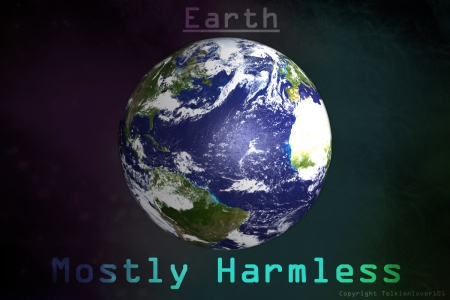
Mostley HarmlessGetting Started – And missing my first deadline in fine writer’s tradition: It might’ve been bubbling away in me for a while without me really noticing but the most definitive beginning I can point to is around 2004. A BBC writing competition invited submission for a 264-word description of planet Earth for the Hitchhiker’s Guide To The Galaxy to replace the previous entry – ‘Mostly Harmless’. I wasn’t a writer but loved the HGTTG radio series and this was too tempting to resist. I wrote my entry, enjoyed myself so much I wrote a second, then couldn’t decide between the two and missed the deadline. I’ve no idea how either might have fared but I still feel a bit of a twit. Nonetheless, the seed was sown. How it grew is harder to explain. A character, an idea for a conversation, a scene, just sort of got written down, then another and another. Most went nowhere, a page or two, a few thousand words, twenty thousand, but petered out. Then one kept going and going until it became obvious I was writing an actual story, with actual characters, and that I was doing this when I should be doing other things, like sleeping. I never decided to write and sat down to do so; the compulsion to write crept up on me and took over. So if you find yourself bleary-eyed at work because you’ve been tapping away at your laptop till the early hours, certain only that you don’t want to stop just yet, then I don’t have to tell you to give in to the urge – it’s already too late.